For a reading, subtract 32 and multiply by 5/9
NIST gives C = (F - 32) / 1.8 for Fahrenheit readings, equivalent to (F - 32) * 5 / 9. The reverse is F = C * 9 / 5 + 32. The 32 accounts for the scales’ different reference points. Moyoutil converts 50°F to 10°C and 68°F to 20°C.
Below are actual function calls and outputs. A reading of 18°F displays approximately -7.77777778°C. Do not use that result for a rise of 18°F. The interface rounds the repeating decimal to at most eight decimal places.
convertUnit("temperature", 50, "F", "C") // 10
convertUnit("temperature", 68, "F", "C") // 20
convertUnit("temperature", 18, "F", "C") // -7.777777777777778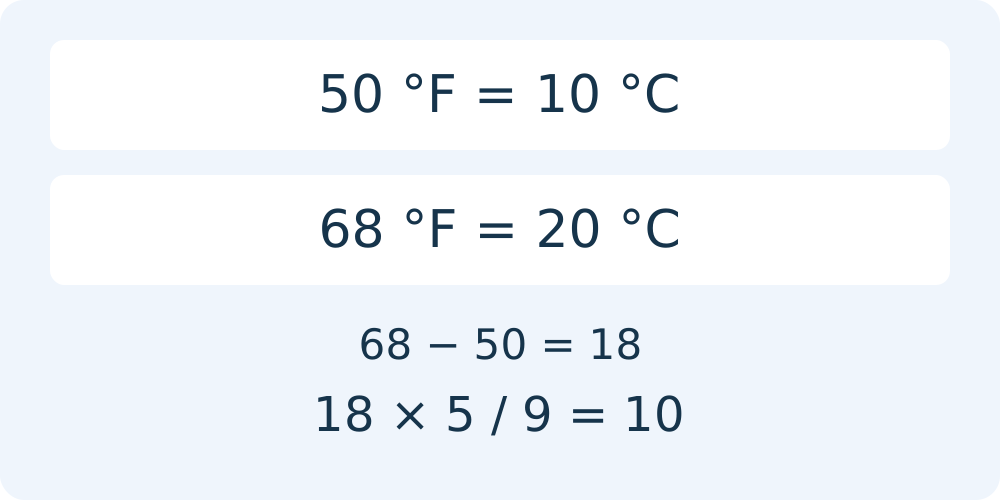
For a temperature change, do not subtract 32
A rise from 50°F to 68°F is 18°F, corresponding to a rise from 10°C to 20°C: 10°C. Subtracting converted endpoints cancels the 32, so change in C = change in F * 5 / 9. NIST lists temperature readings and intervals separately. Preserve the sign of a decrease too.
(68 - 50) * 5 / 9 // 10
20 - 10          // 10
Choose Temperature in the unit converter and select the input and output units. This tool converts readings; it has no separate change mode. Convert the start and end readings separately, then subtract start from end. Keep sufficient precision and round at the end. Results update when inputs change.
Frequently Asked Questions
Do Kelvin conversions also distinguish readings from changes?
A Celsius reading uses K = C + 273.15. Subtracting two temperatures cancels 273.15, so an interval of 1°C equals an interval of 1K. Entering a reading of 1°C gives 274.15K; do not confuse it with a change of 1K.
What about negative inputs and supported limits?
Negative Celsius readings are not automatically errors: the actual function converts -40°C to -40°F. It rejects inputs below its allowed lower limit, such as -274°C. Enter finite numbers and supported units. Measurement uncertainty and instrument calibration are not calculated.