The difference a color palette makes
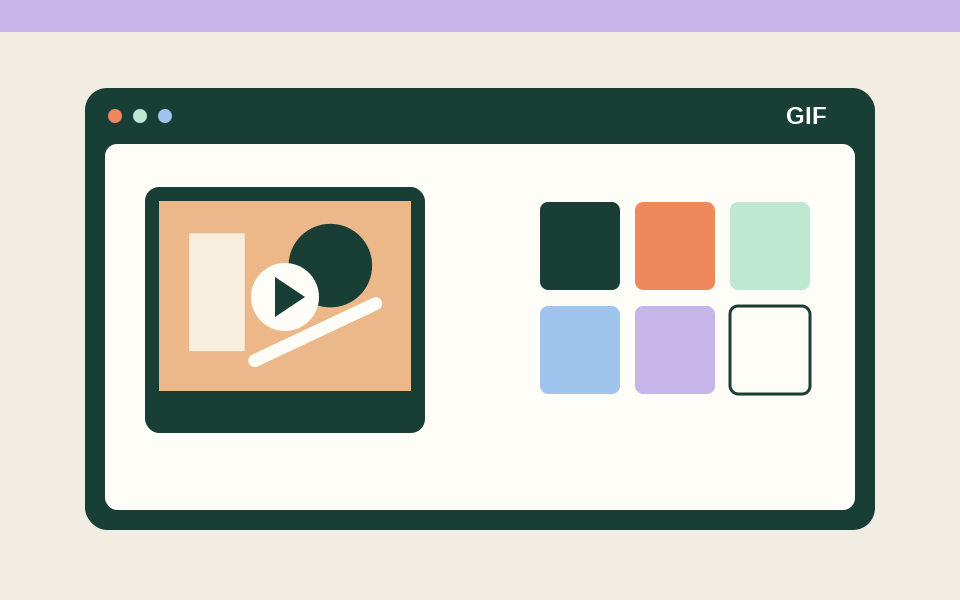
Moyoutil's GIF encoder creates a palette of up to 256 colors from each frame and maps pixels to their color indices. In scenes with a lot of color variation, such as photos, the colors may appear clumped or the gradation may look stair-like. It does not offer dithering or professional color correction features.
Typical video encoders can also leverage similarities between frames, so a GIF of the same scene may be larger than an MP4 or WebM. GIFs do not have audio tracks. If sound is important or your scene is long and complex, compare ways to share it as a video.
Does 256 colors mean the entire animation?
GIF89a distinguishes a global color table shared by the animation from a local color table for one image. Moyoutil uses the first frame’s palette as the global table and writes a new local table for subsequent frames. Each frame’s palette can have at most 256 colors while the colors across multiple frames can total more than 256.
Reproduced synthetic input: we placed 256 nonoverlapping colors in each of two 16×16 RGBA images and ran the current tool’s encoder. Reading the GIF back showed 256 colors in the first global table and 256 in the second local table, with 512 distinct RGB values across both. The diagram shows the actual stored palette values. This does not mean one frame displayed 512 colors.
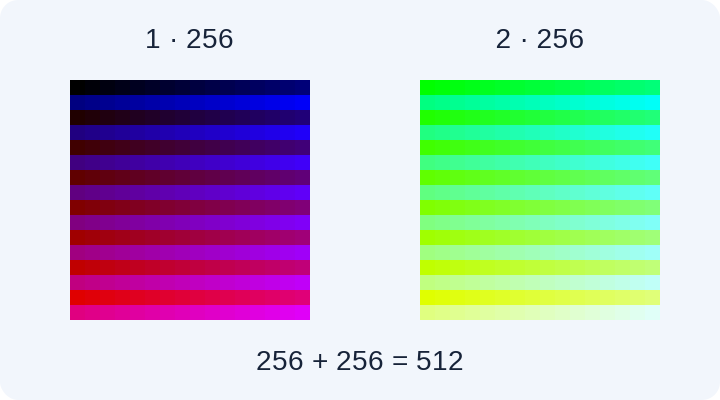
Creating a new palette per frame does not preserve every color in a photo. Each frame still maps pixels to palette colors, and this tool does not use dithering. Compare gradients and small text in the same scene with the original.
Adjusting length, FPS, and pixel size together
Extracting a 5-second clip at 10 frames per second gives about 50 frames. A higher FPS samples motion more frequently but increases the number of frames and the processing work. GIF frame delays use fixed time units, so rounding can make the playback interval differ from the selected FPS.
Moyoutil processes up to 10 seconds and 150 frames, and the long side is up to 640px. Find the screen at each point in the source, encode it sequentially, and set the result to be played repeatedly. The basic order of capacity adjustment is to reduce length, size, and FPS and compare the results. The number of frames visible on screen alone does not provide an accurate estimate of the final file size.
Frequently Asked Questions
Can I add sound to a GIF?
The GIF results from this tool have no sound. If you want to share with sound, use the video format.
Why do the colors in my photos become rough?
This is because the number of colors available in the palette is limited. This tool does not provide dithering.