Try the inputs from this article
Run the example or change the input to compare results. Tool functions and standard browser APIs calculate the results in your browser.
Run example
Changing the input clears the previous result.
Download result JSONThese are illustrative inputs. Result field names are code identifiers; see the article for units and conditions.
The same number 8 can describe different quantities
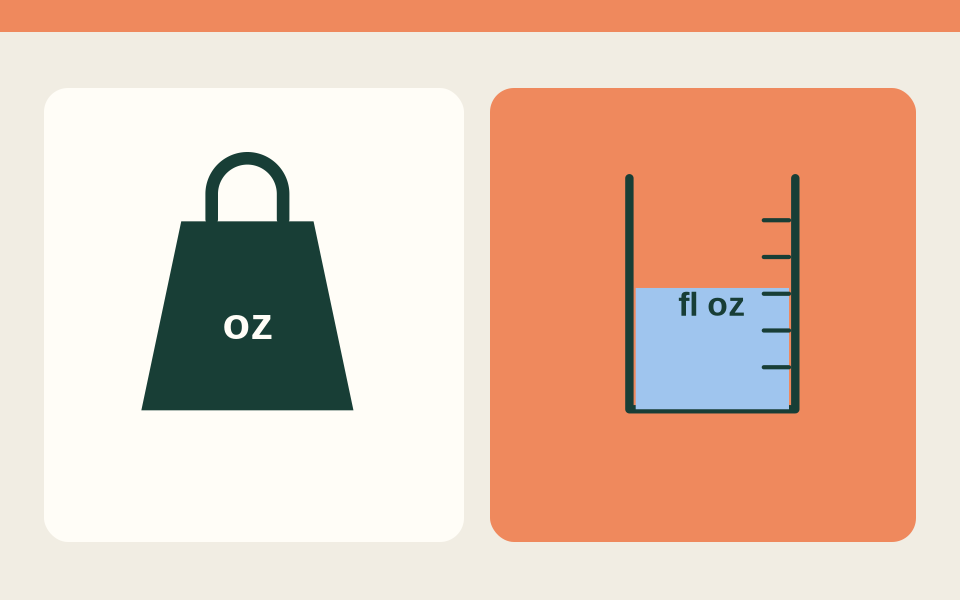
In Moyoutil, converting 8 oz under weight to grams gives about 226.80 g. Converting 8 US fl oz under volume to mL gives about 236.59 mL. Grams and mL describe different quantities, so comparing the numbers does not tell you which is more. NIST likewise classifies oz under mass and fl oz under volume.
8 oz ≈ 226.80 g
8 US fl oz ≈ 236.59 mL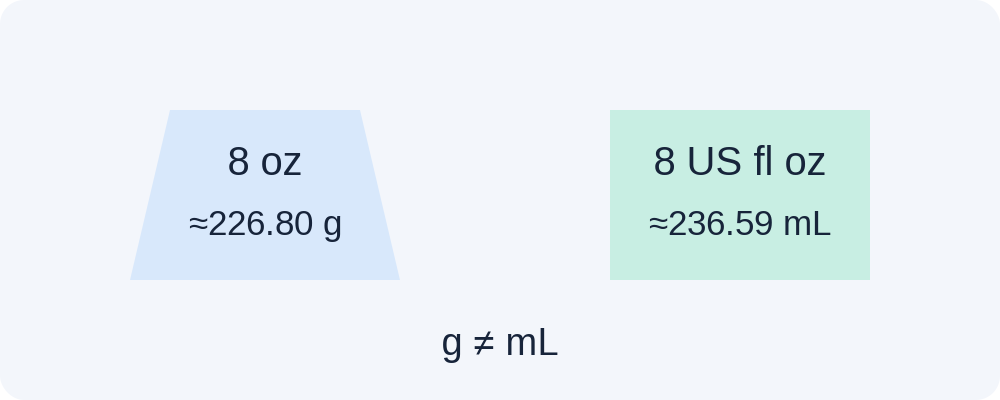
Converting grams to mL requires density
Density is mass divided by volume. If a hypothetical material has a specified density of 0.8 g/mL, 100 mL has a mass of 80 g, while 100 g occupies 125 mL. This is an assumption for calculation, not a measured density of water, oil, or a particular product.
0.8 g/mL × 100 mL = 80 g
100 g / (0.8 g/mL) = 125 mL
For a second hypothetical material at 1.25 g/mL, the same 100 mL has a mass of 125 g, and the same 100 g occupies 80 mL. Compared with the first assumption, equal volumes can have different masses. The diagram compares assumptions, not measured materials.
1.25 g/mL × 100 mL = 125 g
100 g / (1.25 g/mL) = 80 mL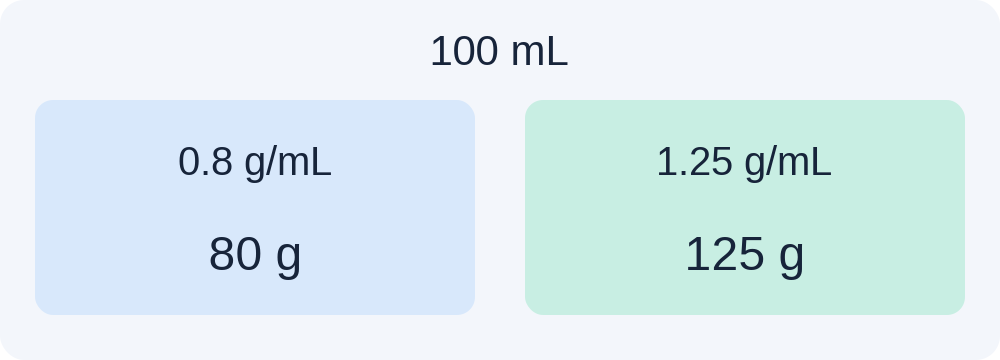
Convert weight and volume separately in the tool. It does not convert between mass and volume or accept density inputs. If a recipe or product description says only ounces, first check oz versus fl oz and whether the fluid measure is US customary. These conversion values do not apply to Imperial fluid ounces or troy ounces for precious metals.
Frequently Asked Questions
Can I always convert 8 oz to 236.59 mL?
No. About 236.59 mL is the volume of 8 US fl oz. Converting 8 avoirdupois ounces of mass to volume requires the density of the material under the relevant conditions.